Signed in as:
filler@godaddy.com

Signed in as:
filler@godaddy.com

Rent-and-possession disputes are often treated as filing problems. At Midwest Litigation & Mediation, LLC, we first approach them as resolution problems.
Before the parties incur the full expense, delay, and disruption of a contested eviction case, we provide a focused opportunity for landlords, property managers, and tenants to determine whether the matter can be resolved voluntarily. The goal is not to delay enforcement or prolong an unworkable tenancy. The goal is to determine—quickly and realistically—whether a clear, written resolution can achieve possession, address unpaid obligations, and reduce unnecessary conflict.
When mediation is not successful or is not appropriate for the circumstances, the matter can move forward into the formal rent-and-possession process without losing momentum.
Many landlord-tenant disputes reach a crisis point only after communication has broken down. Rent may be unpaid, the lease may have expired, notices may have been ignored, or the parties may disagree about possession, property condition, repairs, charges, or move-out expectations.
Immediate filing may be necessary in some cases. In others, a structured conversation with a neutral mediator can produce a faster and more practical result.
Mediation creates a controlled setting in which the tenant, landlord, and property manager can address the actual issues preventing resolution. The mediator helps the participants clarify their positions, identify realistic options, and determine whether a voluntary agreement can be reached.
The mediator does not decide the dispute or force either side to accept a proposal. The participants retain control over whether the matter settles and what terms they are willing to accept.

A mediation-first approach can provide significant benefits to landlords, property managers, and tenants.
A contested rent-and-possession case may involve filing, service attempts, hearings, continuances, judgment, and enforcement. Mediation can establish whether a voluntary resolution is possible before the parties commit to the complete court process.
Early resolution may reduce filing expenses, service costs, preparation time, missed work, property-management time, enforcement expenses, and other costs associated with a contested matter.
A formal proceeding generally produces a limited set of outcomes. Mediation allows the participants to develop practical terms tailored to the property and the circumstances.
An agreed surrender date may give the landlord and property manager a clearer timeline for inspection, repairs, turnover, and re-rental. It may also allow the tenant to arrange an orderly move rather than facing an uncertain enforcement schedule.
A planned transition may reduce the risk of abandoned belongings, missing keys, utility problems, avoidable damage, hostile confrontations, and confusion about the condition of the premises.
When an agreement is reached, the terms can be reduced to writing so that the participants understand their obligations, deadlines, and the consequences of noncompliance.
We offer a wide range of legal services, including family law, estate planning, and business law.

Every rent-and-possession matter is different. Depending on the circumstances, mediation may address:
Mediation does not require a landlord to forgive rent, waive valid rights, or accept an unreasonable proposal. It provides a structured opportunity to determine whether a workable resolution is possible.
Not every matter can be resolved voluntarily. A tenant may refuse to participate, fail to communicate, reject reasonable terms, remain in possession beyond an agreed date, or fail to comply with a written agreement. The circumstances may also require immediate formal action.
When mediation does not resolve the matter, the case can move forward into the appropriate rent-and-possession or unlawful-detainer process.
Because the relevant information has already been collected and organized, the transition can occur without unnecessarily starting over. Tenant information, lease documents, payment records, notices, property information, communication history, and service details can be maintained in a coordinated file for the next phase of the matter.
The objective remains the same: move the case forward efficiently, document each step, and maintain control over the process.
Midwest Litigation & Mediation, LLC brings approximately 25 years of experience working with rent-and-possession matters.
That experience includes issues arising from:
This experience helps identify potential problems before they cause avoidable delays. Names, addresses, occupancy information, notices, service locations, payment histories, and supporting documents can be reviewed early so that the matter is better organized if formal action becomes necessary.
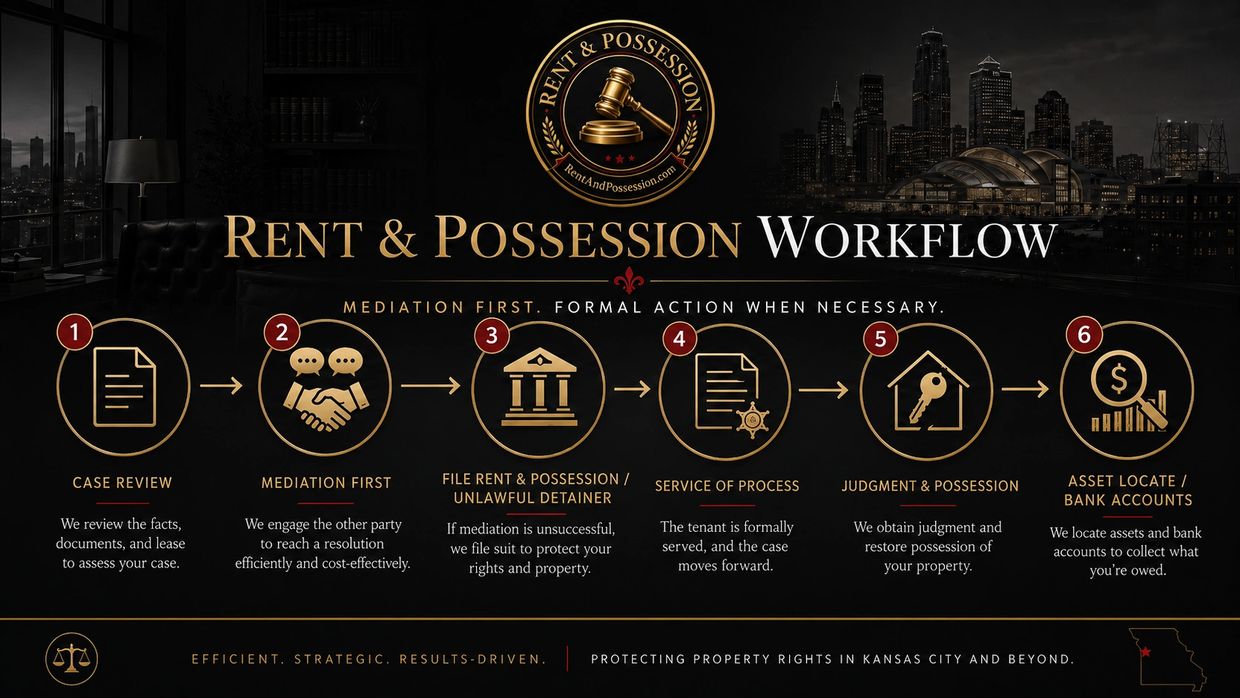
A rent-and-possession matter may involve several different functions: communication, mediation, document collection, service of process, investigation, case tracking, and post-judgment asset research.
Midwest Litigation & Mediation, LLC provides a coordinated, in-house approach to these functions. Rather than sending the client from one unrelated provider to another, the matter can remain within a single organized workflow.
The process begins with gathering the information necessary to understand the tenancy, the property, the parties, the payment history, the notices provided, and the desired outcome.
Potential problems can be identified early, including incomplete tenant information, inconsistent names, unclear lease terms, missing notices, outdated addresses, unidentified occupants, and service concerns.
When appropriate, the parties are contacted for a focused attempt to resolve the matter voluntarily. The mediation may be conducted remotely or in another agreed format.
The objective is to determine whether the parties can reach clear terms concerning payment, possession, move-out, property condition, or other disputed issues.
If mediation is unsuccessful, the information already gathered can be organized for the formal filing process. This reduces duplicate intake, repeated document requests, and gaps created by transferring an incomplete file between unrelated providers.
Process service can be coordinated in-house, allowing service attempts, address information, occupancy observations, and status updates to remain connected to the same matter.
When a defendant or occupant is difficult to locate, investigative resources can be used to identify updated addresses, employment information, related properties, or other lawful leads that may assist with service.
A judgment does not automatically result in payment. When lawful post-judgment collection efforts are appropriate, investigative work may be used to identify potential sources of recovery.
Depending on the circumstances and the information legally available, post-judgment research may include efforts to identify:
Asset identification does not guarantee collection. Any garnishment, execution, levy, or other enforcement measure must be pursued through the applicable legal process.
Rent-and-possession matters can lose time when information is scattered among property managers, mediators, filing personnel, process servers, investigators, and collection providers.
Our coordinated approach is designed to reduce those gaps.
The same core file can follow the matter from:
Initial review → mediation → formal filing support → service of process → case tracking → post-judgment asset research
This continuity helps preserve important information, reduce duplicate work, improve accountability, and provide the client with a clearer understanding of where the matter stands.
Mediation is a neutral process. During mediation, the mediator does not represent the landlord, property manager, tenant, or any other participant.
If mediation concludes without an agreement and additional process-service, investigative, or case-support work is requested, those services are handled separately from the mediation function. Any later work should begin only under a separate engagement, after appropriate review, and in a manner that protects confidential mediation communications.
Information disclosed privately during mediation is not used as an investigative or enforcement shortcut.
This separation protects the integrity of the mediation process while allowing clients to access coordinated services when a voluntary resolution is not achieved.
The goal is not simply to file a case. The goal is to resolve the possession problem as efficiently and responsibly as possible.
That may mean reaching an agreement before filing. It may mean moving forward with a formal rent-and-possession or unlawful-detainer matter. It may require difficult service, investigative support, post-judgment research, or additional enforcement steps.
Midwest Litigation & Mediation, LLC provides a practical process that begins before filing and can continue through the identification of potential assets after judgment.
Copyright © 2026 MidWest Litigation and Mediation, LLC - All Rights Reserved.

We use cookies to analyze website traffic and optimize your website experience. By accepting our use of cookies, your data will be aggregated with all other user data.